ContrastCVE Shield

Stop CVE exploitation in real time.

Contrast CVE Shield detects and blocks exploitation of known vulnerabilities in live production applications — even before a patch exists.
Powered by Contrast ADR.

Join the waitlist
Background Image

The threat landscape has changed

AI is compressing the window between disclosure and exploitation. Your patch cycle has not kept up.

51%

of CVEs published during 2024-2025 were hacked by AI without human intervention" 1

28.3

of CVEs are exploited within 24 hours of disclosure 2

70%

of security team hours spent on false positives 3
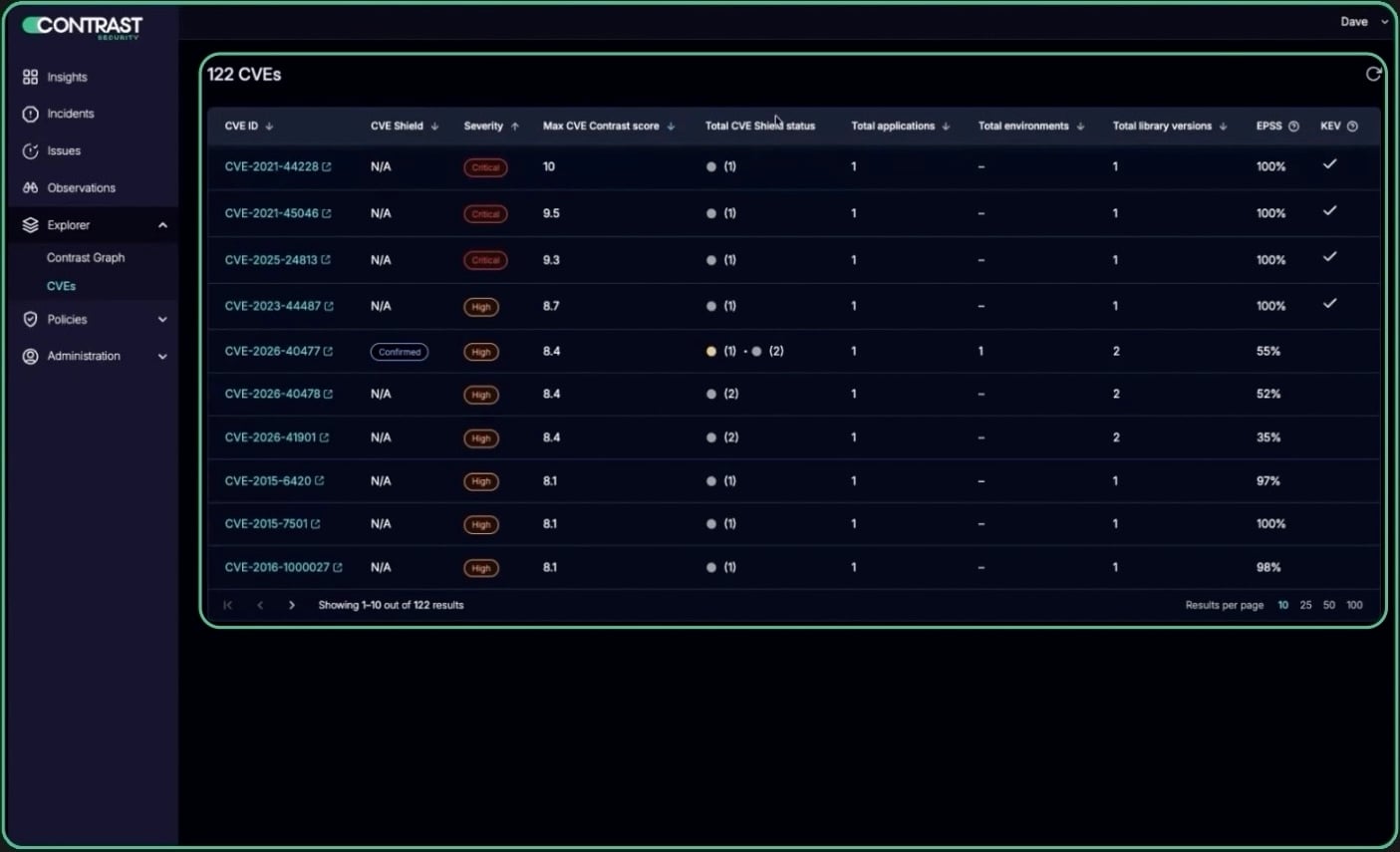
From vulnerability disclosure to active protection in minutes

Exposure confirmation

  • Focuses on the less than 5% of CVEs that are exploitable
  • Helps prioritize and patch what's reachable
  • Ensures everything else moves to the bottom of the backlog

Exploitation detection

  • Detects when a CVE is actively triggered in a live exploitation attempt
  • AI-generated and manually crafted payloads both detected
  • High-signal incidents linked directly to CVE ID blocking real exploits from happening

Active blocking

  • Prevents Remote Code Execution and other common exploit techniques
  • Stops exploits based on what they do inside the application, not what they look like at the perimeter
  • Legitimate application functionality continues uninterrupted, near-zero latency overhead
How it works

When exploitation is detected, a microsandbox activates and blocks the attack

1

CVE Shield definition deployed

Contrast deploys shield definitions to all instrumented environments without requiring a restart.
2

Microsandbox activated

Each CVE gets a tailored microsandbox scoped to the vulnerable method. Normal library functionality continues. Only dangerous capabilities are intercepted.
3

Instant visibility

Immediately see where the CVE exists in your environment, where vulnerable code is actively running, and where it's being targeted by attackers — all before a patch exists.
4

Exploit attempt detected

When an attacker triggers the vulnerable path — whether by hand or using AI-generated payloads — CVE Shield intercepts the dangerous system-level capability before damage occurs.
5

Incident auto-generated

A pre-enriched incident is created with full stack trace, HTTP request, CVE ID, CWE classification and the blocked capability. SOC analysts get context, not noise.
Zero overhead for non-vulnerable code paths.
12 nanoseconds.
No code changes.
One install, continuous coverage.

Built for security teams facing AI-speed threats

  • CISO: Definitive risk posture proof

    Answer "Are we protected?" immediately after disclosure. Per-CVE reporting maps active runtime defenses to the CVEs your board, auditors and customers ask about.

  • AppSec: Exploitability-driven triage

    Stop spending time on CVEs that are not exploitable in production. Exposed, Exploited, and Blocked status filters surface what actually matters in one view.

  • SOC: Pre-enriched incident queue

    Every blocked exploit attempt auto-generates a closed incident with CVE ID and CWE. No manual reconstruction.

  • AI-generated attacks blocked

    Capability-based blocking intercepts the dangerous system call regardless of how the exploit was crafted — including AI-generated payloads that vary inputs to evade signatures.

  • Zero patch-cycle dependency

    CVE Shield is active within minutes of Contrast releasing a new definition — before most teams finish initial triage and long before a vendor patch is available.

  • CVE protection layer

    CVE Shield brings targeted, per-CVE protection — adding runtime reachability confirmation and exploit blocking scoped to the exact vulnerable method.

From version scanning to real-time CVE enforcement

Zero day and emergency response

CVE Shield is updated automatically — before most teams finish their investigation and before AI-powered attacker tooling has adapted. No emergency rebuild. No waiting for patch cycles.

contrast--bg-alerts-internal
Exploitability confirmation and backlog prioritization

Shielded and non-exploitable CVEs move to the bottom of your backlog automatically. Actively exploited CVEs surface to the top. Stop spending engineering hours on theoretical risk as AI development tools accelerate CVE volume.

contrast--bg--infinite-depth--blocks
High-fidelity SOC incident response

Every blocked exploit attempt generates an enriched, auto-closed incident with CVE ID and CWE. As AI-assisted attacks increase in frequency, automated enrichment is the only sustainable model.
contrast--bg-alerts-timeline
Compliance and SBOM accountability

CVE Shield acts as a compensating control while patches are pending — providing per-CVE runtime proof of protection that satisfies board members, auditors and SBOM accountability demands.

contrast--bg-dissolving-circle__white-bg

Stop the next CVE exploit before it starts.

Stop the next CVE exploit before it starts — safely, with no impact to functionality or performance. CVE Shield gives security teams definitive protection — confirming exploitability, detecting active attacks and blocking dangerous behavior in real time. Whether the threat is a human attacker or AI-generated exploit code, CVE Shield stops it at the capability level without touching legitimate application behavior.

"Blind CVE triage ends when you can see what's actually executing in production. CVE Shield shows you if vulnerable code is exploitable, proves whether it's being exploited, and lets you stop it before a patch exists." Jeff Williams - Founder, OWASP & CTO, Contrast Security
"Capabilities that connect CVE identification with runtime exploitability and active protection represent an important step toward more operationally relevant application security." Katie Norton, Senior Research Manager, IDC
Background Image

FAQ

  • Real-time CVE exploitation protection is a proactive security defense that detects and blocks threats targeting known Common Vulnerabilities and Exposures (CVEs) inside live production applications. Unlike traditional patching cycles, this method stops active exploit payloads at runtime before a software fix can be deployed, minimizing an organization's exposure window during zero-day events.
  • Capability-based microsandboxing applies an isolated, highly targeted security boundary around a specific vulnerable method within an application. By scoping the sandbox directly to the vulnerability, the system intercepts only unauthorized, high-risk system calls—such as remote code execution or file writes—while allowing the rest of the application’s legitimate functions to proceed normally.
  • Yes. CVE Shield neutralizes AI-generated exploit payloads by focusing on the underlying system-level capability being exploited rather than relying on traditional, static input signatures. Because AI-crafted attacks constantly vary their syntax to bypass input filters, blocking the unauthorized execution technique at the runtime layer ensures consistent mitigation regardless of payload variations.
  • Real-time protection via CVE Shield is built with minimal execution overhead to satisfy demanding production requirements. The solution introduces zero latency for non-vulnerable code paths across the application ecosystem. For isolated code paths actively restricted by a microsandbox definition, it introduces a negligible latency overhead of just 12 nanoseconds.
  • Exploitability confirmation verifies whether a vulnerable line of code actually runs in your live production environment. By distinguishing theoretical vulnerabilities from genuine runtime exposure, security teams can automatically deprioritize non-exploitable libraries, helping AppSec professionals focus engineering resources on high-signal threats that present immediate organizational risk.
  • Automated CVE mitigation provides continuous runtime evidence of protection for security teams, board members, and auditors validating the integrity of Software Bill of Materials (SBOMs). Rather than relying on static assumptions, it delivers granular, per-CVE proof that active defenses are blocking execution paths, meeting stringent compliance frameworks requiring verified vulnerability defense.
  • CVE Shield currently supports Java applications running on the JVM. Support for Go, Node.js, .NET and Python is planned for the second half of 2026. If your environment includes any Java services that handle external input, they typically have the highest attack surface, regardless of what else you run, making them a practical starting point for coverage.
  • CVE Shield is designed to avoid this. Every shield can run in Monitor mode first, which logs capability violations without blocking anything, giving your team 1–2 weeks of real production traffic to confirm legitimate behavior isn't affected. Once you're confident in the baseline, you advance individual shields to Block mode — independently for each CVE. There's no global on/off switch, so you can enforce the CVEs you're confident about while continuing to monitor others.
  • CVE Shield uses the Contrast agent, a one-time install with no code changes and no application restart required. For Kubernetes environments, the Contrast Kubernetes Operator can deploy CVE Shield across an entire cluster in a single operation. Once installed, new CVE shield definitions automatically reach your running agents.
  • CVE Shield is a runtime protection capability built into the Contrast agent and delivered as part of Contrast ADR. It extends the same runtime instrumentation and telemetry pipeline ADR uses, so exploitation attempts CVE Shield blocks generate incidents directly in your existing ADR queue, enriched with CVE ID and CWE mapping.
  • Yes. CVE Shield is available on a free tier with no credit card and no sales call required. You can connect your applications and start seeing CVE reachability and exploitation data in minutes. See our pricing page for what's included at each tier.