Contrast Assess
Secure every line of code with industry-leading accuracy

Traditional approaches to application security that rely on scanning lines of code for known vulnerabilities, lack visibility and accuracy. As a result, they depend on manual security checks by expert staff to triage and interpret the results before handing recommendations with limited context back to developers to fix the problems. This inefficiency inhibits development cycles, increases costs and often fails to eliminate many vulnerabilities that can be exploited by cyberattacks.
Contrast Assess uses instrumentation to embed security directly into the development pipeline. It automatically identifies and diagnoses software vulnerabilities in applications and Application Programming Interfaces (APIs), thereby enabling organizations to release secure software faster and with fewer risk exposures.
Traditional testing tools miss too many critical vulnerabilities
Legacy application security solutions, such as Static Application Security Testing (SAST) and Dynamic Application Security Testing (DAST), either scan an application’s source code or use brute force attacks to find vulnerabilities. As a result, their outside-in approach lacks awareness of the full application context, leading to both false positives and false negatives.
These inaccuracies create noise that interferes with effective prioritization of vulnerabilities which can increase application risk posture.1
These traditional AppSec tools are slow, require experts to manage and need significant infrastructure investment to deploy. They depend on security teams to manually triage and interpret “noisy” results. These are then returned to development teams (often in the form of a PDF list) without the full context of the vulnerability or prioritization. As a result, developers spend valuable time tracing the root cause of the vulnerabilities and then verifying successful remediation.
Contrast Assess automatically identifies and diagnoses software vulnerabilities in applications and APIs by using instrumentation to pinpoint and prioritize software vulnerabilities. By embedding sensors that monitor runtime behavior within the application, organizations can discover vulnerabilities earlier in the SDLC.
This approach provides the highest level of accuracy, efficiency and coverage possible. Contrast Assess enables companies to significantly decrease security team triage and DevOps remediation expenses. In addition, reducing alert noise (caused by false positives) helps eliminate hours of work required of DevOps teams to find and fix vulnerabilities without in-depth understanding of a specific vulnerability’s priority.
Identify hidden application vulnerabilities by continuously analyzing code in real-time for security risks
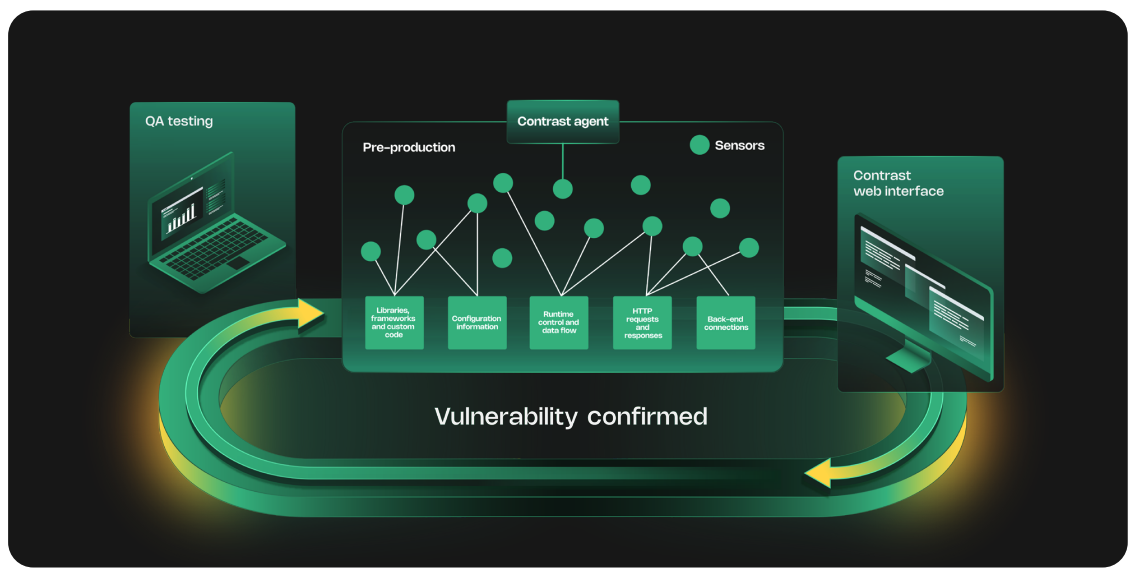
Eliminate deployment delays with proactive IAST that finds vulnerabilities faster
Contrast Assess uses real-time intelligence and continuous visibility to quickly detect and remediate security risks with fewer false positives and false negatives. Contrast's approach was purpose-built for modern DevOps environments, making it easier to prioritize and fix critical vulnerabilities as developers test and write code. Contrast Assess supports languages such as Java, Node, .Net, Python and many more.
Real-time accuracy
Automatically identifies and diagnoses software vulnerabilities in applications and APIs by using instrumentation to pinpoint and prioritize software vulnerabilities with low false positives, providing immediate feedback during development and QA.
Developer-centric insights
Pinpoints the exact line of code and provides full stack trace and remediation guidance, empowering developers to fix issues quickly, significantly decreasing security team triage and DevOps remediation expenses.
Seamless integration
Operates continuously and passively within existing development and testing environments (CI/CD pipelines, QA), requiring no specialized security scans or reconfigurations and creates an instant feedback loop, providing developers with immediate and continuous threat vulnerability visibility.
Comprehensive coverage
Identifies a wide range of critical vulnerabilities, including OWASP Top 10, common weakness enumeration (CWE) and more, across various languages and frameworks, diagnosing data flows and analyzing requests and responses, interrogating application frameworks to determine all data routes.

You can't stop what you can't see
Schedule a demo and see how to eliminate your application-layer blind spots.
Book a demo