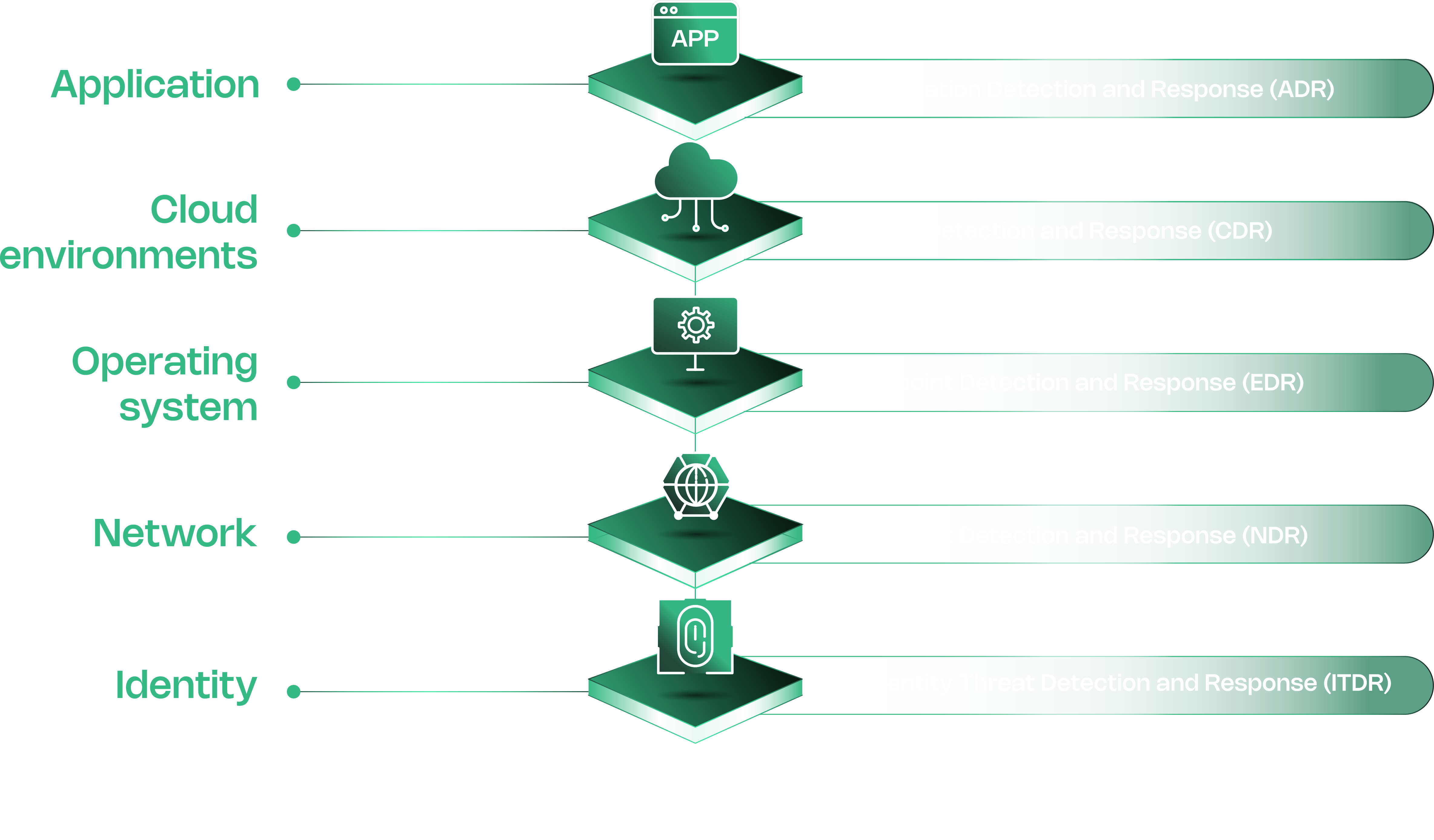
Moving beyond RASP security: Application Detection and Response (ADR)

Go beyond blocking. Connect
real-time protection with unified detection, response and remediation.

Try Contrast
Background Image

Applications and APIs are under constant attack

The landscape has changed, creating an urgent demand for a new class of defense.

33%

of all breaches begin with exploiting a software vulnerability. 1

14,250

attacks, on average, hit applications every month. 2

17+

new vulnerabilities are added to the average application backlog every month. 3

AppSec is accountable for defending applications, but is not built for 24/7 incident response. 24/7 SecOps is built for response, but lacks the deep application visibility.

Unless an organization is confident it produces perfect code and uses perfect libraries, a new approach is needed.

The evolution of application defense:
Why RASP is not enough

2000s | WAF

Web Application Firewall (WAF) focused on filtering HTTP traffic to web applications and web APIs. However, it lacked visibility into application logic, burying teams in noise without knowing if an attack actually succeeded.

2010s | RASP

Runtime Application Self-Protection (RASP) embedded security inside the application to stop exploits at the source. However, RASP operated as a siloed tool, great at blocking attacks, but left SecOps blind to the incident details and AppSec without a quick path to resolution.

NOW | ADR

Application Detection and Response (ADR) was pioneered by Contrast Security in early 2024. It fills the application-layer gap in the broader detection and response ecosystem, integrating runtime protection and visibility directly into SecOps workflows.

The evolution: Application Detection and Response (ADR) unifies AppSec, SecOps, and Development. ADR connects real-time protection with detection, response, and remediation workflows to close the gap between RASP blocking a threat and fixing the underlying vulnerability.

Application Detection and Response (ADR) directly observes and analyzes software behavior from within running applications and APIs. It identifies and blocks active attacks, while monitoring and remediating underlying vulnerabilities targeting custom code, libraries and frameworks.

Modern deployment | Native SOC integrations | Performance innovation
Full incident traces | Graph technology | Streaming architecture

Complete runtime protection must link to response and remediation workflows

ADR is built upon a modern streaming graph architecture to operationalize the "inside-out" concept pioneered by RASP, connecting SecOps' active defense with AppSec's risk reduction.
Detection and response
  • Inline blocking: Enable blocking when necessary to stop attacks before full execution.
  • Native SIEM data: Send verified, code-level incidents to your SOC.
  • Incident trace: Give responders a visual execution path of the attack.
  • Attack runbooks: Enable automated, real-time responses..
  • Behavioral detection: Identify and block novel and zero-day attacks.
Risk prioritization and attack surface reduction
  • Attack-to-vulnerability mapping: Know the exact vulnerability that's under attack.
  • Vulnerability prioritization: Focus developers on the few risks that matter.
  • AI-powered attack surface reduction: Agentic AI workflows for automated code fixes.
  • Vulnerability class elimination: Neutralize entire categories of vulnerabilities at once.
  • Full developer context: Provide code-level details for faster fixes.

Ensure the same attack can't happen twice

Attack verified and blocked → Vulnerability confirmed → AI SmartFix generated
 
See it in action

The Contrast Graph: Context beyond RASP for detection and response


All unified by the Contrast Graph, our real-time streaming data model that connects attacks, vulnerabilities and code.

CS_Contrast Graph

From detect to defend: Stop attacks in real-time with ADR

  • Detect real threats in real time

  • Focus on what's real, not perimeter noise

  • Put vulnerabilities in context for prioritization

  • Block attacks when necessary

Ready to move beyond RASP?

See how Contrast ADR goes beyond the core strengths of RASP to deliver complete protection, detection and remediation.

Explore Application Detection and Response

FAQ

  • RASP is a security technology that embeds protection directly into the running application to stop exploits at the source. By detecting how code processes data, it can protect against entire classes of vulnerabilities—such as untrusted deserialization—and neutralize zero-day attacks (like Log4j) without requiring prior knowledge or signatures.
  • Traditional RASP blocks attacks effectively but often operates in a silo. It typically lacks a streaming graph architecture to connect those blocked attacks to the underlying vulnerabilities. This leaves SecOps blind to the incident context and AppSec without a clear path to remediation.
  • ADR is built from the ground up on a modern streaming architecture designed for a detection and response strategy. While it enables the same critical protection and blocking outcomes as RASP, it utilizes a graph-based data model to create a real-time digital twin of the application. This architecture allows ADR to stream context rich telemetry to SecOps and correlate threats to vulnerabilities for AppSec.
  • A WAF sits at the perimeter and inspects traffic, meaning it can only infer a threat based on a suspicious payload, without knowing if it will actually work. A modern RASP operates inside the code, where it ideally uses behavioral detection to see how the application processes that data. It knows definitively if a vulnerability was hit and if the attack was successful, eliminating the guesswork.
  • Traditional RASP focuses on blocking, not prioritizing. ADR evolves this by connecting real-time attack data to your existing vulnerability backlog. By confirming exactly which vulnerabilities are being targeted by attackers in the wild, teams can prioritize fixing the true risks rather than wasting time on theoretical ones.
  • Yes, a sophisticated RASP can. By monitoring for malicious behaviors (like unexpected command execution) rather than specific signatures, it can stop novel zero-day attacks immediately. Furthermore, it can neutralize entire classes of vulnerabilities by enforcing secure architecture at the framework level, preventing exploitation even if the specific flaw is unknown.